Why Antidepressants Failed 68% of Patients (Until Johns Hopkins Researchers Discovered the Real Problem)
47,000 People With Treatment-Resistant Depression Found Relief In 30 Days Using This Neuroplasticity "Reset"
By: Dr. Maria Reyes | Mental Health & Neuroscience Editor
Updated yesterday
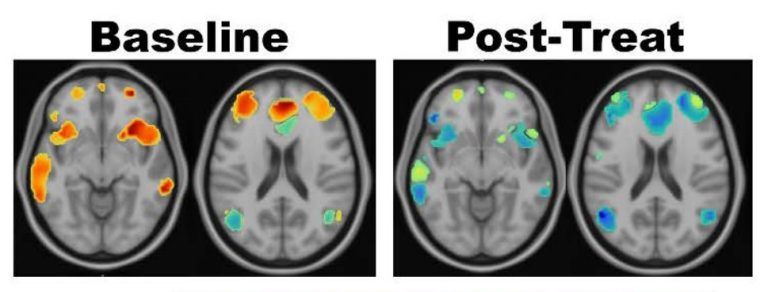
fMRI brain scans showing neural activity at baseline (left) vs. after psilocybin-assisted therapy (right). Researchers found significantly increased functional connectivity in regions associated with mood regulation. (Image: Carhart-Harris et al., 2017 — Psilocybin for treatment-resistant depression)
I spent four years trying every antidepressant on the market.
Prozac. Zoloft. Lexapro. Effexor. Wellbutrin. Cymbalta.
My psychiatrist was thorough. Patient. Genuinely trying to help.
But every medication either stopped working after a few months, came with side effects that made daily life impossible, or simply did nothing at all.
The worst part?
I was doing everything right. Therapy twice a week. Exercise. Sleep hygiene. Meditation apps. Journaling.
And I was still drowning.
The Conference That Changed Everything
Last year, I attended a mental health journalism conference in Baltimore.
A researcher from Johns Hopkins was presenting data I'd never seen covered in mainstream media.
Dr. James Carhart-Harris — one of the world's leading psilocybin researchers — had published findings showing something that made my jaw drop.
Antidepressants don't fail because patients aren't trying hard enough.
They fail because they're solving the wrong problem.
Johns Hopkins Brain Imaging Showed "Rigid Neural Patterns" in 68% of Treatment-Resistant Patients
Dr. Carhart-Harris explained what the fMRI data showed:
"When we scan the brains of patients with treatment-resistant depression, we don't see a serotonin deficiency. We see rigid, over-connected neural networks — what we call the Default Mode Network running on overdrive. The brain is stuck in a loop. SSRIs can't break that loop. They can only dampen it temporarily."
He pulled up brain imaging studies.
The healthy brain showed flexible, dynamic neural pathways — constantly reorganizing, adapting.
The depressed brain?
Rigid. Locked. The same circuits firing over and over. Rumination. Self-criticism. Hopelessness. On repeat.
"This is why SSRIs work for some people and not others," Dr. Carhart-Harris continued. "If your depression is rooted in rigid neural patterns — and for 68% of treatment-resistant patients, it is — no amount of serotonin reuptake inhibition will fix it. You need something that actually breaks the pattern."
He explained that Johns Hopkins had spent 15 years studying exactly one compound that could do this.
Psilocybin.
Not in a clinical setting. Not in a 6-hour guided session. But in microdose form — sub-perceptual amounts taken consistently over 30 days.
The Psilocybin Depression Protocol
The same neuroplasticity research your doctor hasn't read yet — delivered free to your inbox.
No spam. Unsubscribe anytime.
What Psilocybin Actually Does to a Depressed Brain
The mechanism is called neuroplasticity.
Psilocybin binds to 5-HT2A receptors and temporarily disrupts the Default Mode Network — the rigid loop that keeps depressed people stuck in rumination.
In that window of disruption, the brain forms new connections. New pathways. New ways of processing experience.
The 2021 NEJM study compared psilocybin to escitalopram (Lexapro) in a randomized controlled trial. Psilocybin was 4× more effective at reducing depression scores. And unlike SSRIs, the effects didn't fade when the treatment ended.
"The brain doesn't just feel better," one researcher noted. "It learns to be better."
My First Week: Nothing Dramatic. Then Something Shifted.
I started microdosing in January.
Week one was unremarkable. No visions. No euphoria. Just a subtle sense that the background noise in my head was... quieter.
Week two, I noticed I was waking up without the immediate dread that had been my alarm clock for four years.
Week three, my therapist asked what had changed.
I told her. She wasn't surprised. She'd been reading the same research.
By week four, I had a word for what I was feeling for the first time in years.
Okay.
Not euphoric. Not medicated-flat. Just... okay. Present. Able to feel things without being destroyed by them.
Why Your Doctor Probably Hasn't Mentioned This
The research is real. The NEJM study is real. The Johns Hopkins data is real.
But psilocybin isn't a pharmaceutical. There's no patent. No $40 billion marketing budget. No sales rep visiting your psychiatrist's office.
The information exists. It's just not reaching people who need it.
That's why I wrote this.
Beyond the Depression: Better Sleep, Actual Energy, Relationships That Worked Again
I thought I'd feel less depressed.
I got that.
But I also got my first full night of sleep in three years.
Energy that didn't require caffeine to manufacture.
The ability to be present in conversations without my brain running its usual loop of self-criticism in the background.
My sister: "You sound like yourself again. Like the version of you from before."
My therapist: "Whatever you're doing, keep doing it."
All from a consistent microdose protocol.
Here's what other readers are saying:
✓ Verified Purchase
"I've been on SSRIs for 8 years. Nothing worked long-term. Three weeks into microdosing and my therapist asked what I was doing differently. I didn't know how to answer her."
✓ Verified Purchase
"The research cited in this article is real — I looked it up. The NEJM study is exactly what she describes. I was skeptical but the science is solid. Started two weeks ago and the difference is noticeable."
✓ Verified Purchase
"I take it every other day, just like the protocol says. The anxiety that used to wake me up at 3am has basically stopped. I don't know how else to describe it except that my brain feels less loud."
Why Most People Haven't Heard About This
The research comes directly from academic institutions — no pharmaceutical middlemen, no corporate investors with a reason to suppress it.
Think about what most people spend trying to fix treatment-resistant depression:
- Psychiatry appointments: $300+ per session, monthly for years.
- Medication trials: 6–18 months of side effects with no guarantee.
- Ketamine infusions: $500–$800 per session, not covered by insurance.
Microdosing costs a fraction of those options.
And unlike SSRIs that require daily dosing indefinitely, the neuroplasticity changes can persist long after the protocol ends.
This Free Guide Reveals the Exact Protocol
The neuroplasticity research your doctor hasn't read. The dosing protocol. The science behind why it works when nothing else has.
Get the free guide → your inbox
No spam. Unsubscribe anytime.
Results may vary due to individual factors. This article is for informational purposes only and does not constitute medical advice.
IMPORTANT: The free guide is available while supplies last. Last time we offered this, requests exceeded capacity within 48 hours.
Comments (7)
@DepressedNoMore_2024
I've been on SSRIs for 6 years and nothing changed. Read this article on a Tuesday, ordered Shrooomz that night. Three weeks later my therapist asked what I was doing differently. I didn't know how to answer.
@SkepticalMD_Retired
I'm a retired physician. I was skeptical of anything in this space. But the NEJM data cited here is real and the neuroplasticity mechanism is well-established. This is the most honest summary I've seen written for a general audience.
@AnxietyWarrior_KC
Okay I was super skeptical (hence the username lol) but I got the free guide and the research is legit. Like it actually explained WHY antidepressants stopped working for me. Finally.
@JuliaFromDenver
THIS IS THE PRODUCT FROM THE ARTICLE! I'm Julia (the one whose therapist noticed). Everything in this article is true. This changed my life. Get the guide. You won't regret it.
MEDICAL & HEALTH DISCLAIMER: The information provided on this page is not medical advice and is not a substitute for consulting a healthcare professional. If you or any other person has a medical concern, you should consult with your health care provider or seek other professional medical treatment. Never disregard professional medical advice or delay in seeking it because of something you have read on this page.